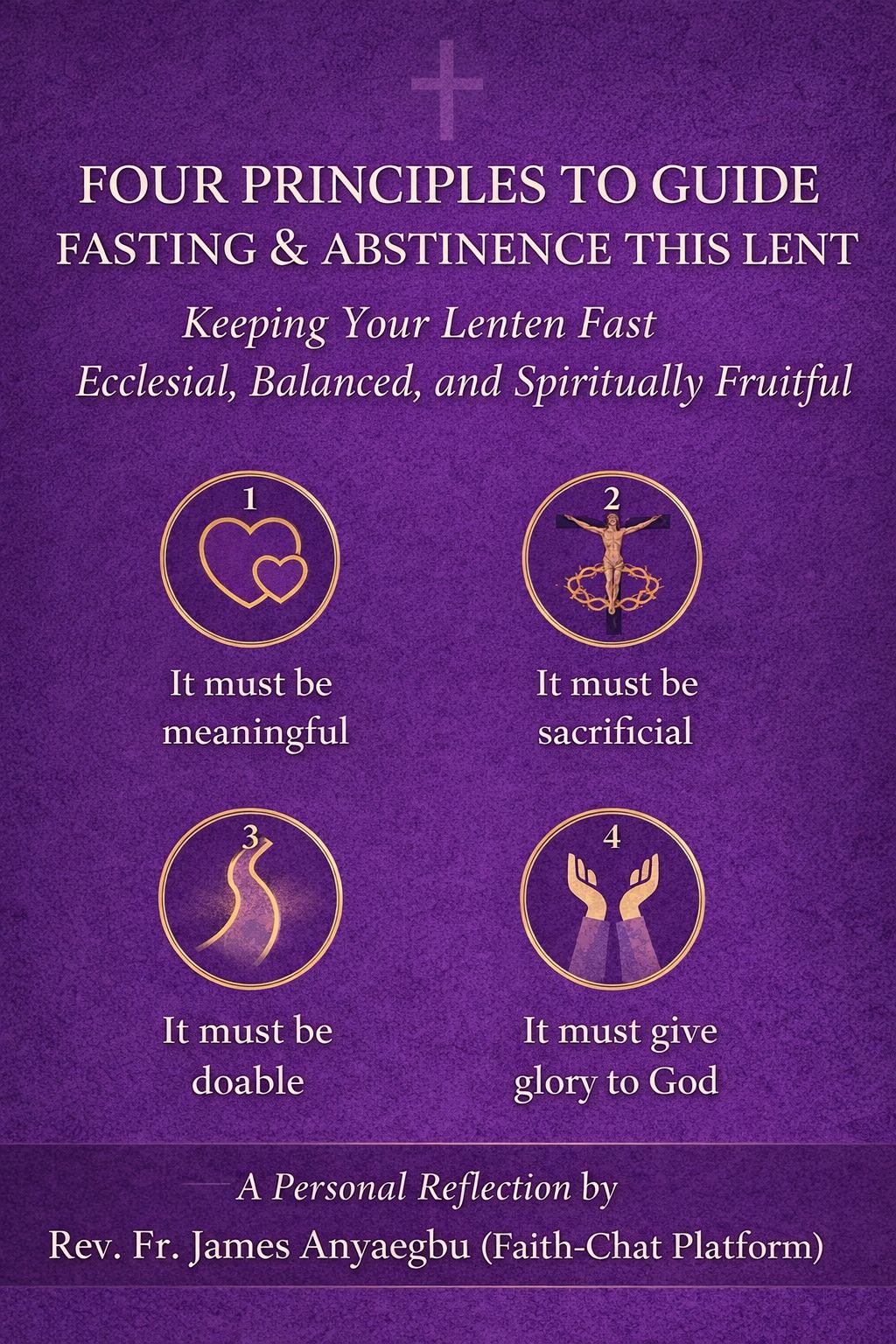
4 Guiding Principles for Fasting or Abstinence.
Before choosing a Lenten fast or act of abstinence, the Church urges prayerful discernment rather than impulse. Lent is ordered toward conversion of heart, deeper communion with Christ, and preparation for Easter.
In my personal reflection, I propose four guiding principles to keep fasting and abstinence ecclesial, balanced, and spiritually fruitful. Our fast must fulfil all four to be spiritually complete. If one element is missing, the practice may still be good, but it remains partial. Lent is not random deprivation; it is integrated conversion, where interior repentance is expressed outwardly through disciplined acts of penance.
1. It must be meaningful
A fast can be sacrificial yet not meaningful. For example, giving up something you rarely do may cost little spiritually, even if technically it is a deprivation. Meaningfulness concerns relevance to your actual spiritual struggle. The fast should confront a real attachment, habit, or weakness that affects your love of God and neighbour. If it does not touch your heart, it will not transform it.
2. It must be sacrificial
Sacrifice implies cost. Without cost, there is no offering. A fast might be meaningful and even doable, but if it requires no real self-denial, it does not train the will. The Church’s penitential tradition exists to discipline desire and unite us to Christ’s self-giving. At the same time, something can be sacrificial but not meaningful, such as taking on a harsh practice that does not address your spiritual needs. That becomes endurance rather than conversion.
3. It must be doable
The Church is prudent and pastoral. A fast or abstinence must be sustainable for forty days (excluding Sundays) or within its allotted time like Ash Wednesday, Fridays of Lent and Good Friday. Something may be meaningful and sacrificial but unrealistic, leading to frustration or abandonment. That undermines growth in virtue. Discipline in Lent should cultivate fidelity, not collapse under excess zeal. Doable does not mean easy; it means prudent and consistent.
4. It must give glory to God
This is the final measure. A fast may be meaningful, sacrificial, and doable, yet still fail if it turns inward, like feeding pride, comparison, or self-congratulation. The Lord warns against fasting “to be seen” (Matthew 6:16–18). If the practice does not deepen prayer, humility, charity, and dependence on grace, it lacks its proper end. All penance is ordered toward love and worship.
In summary, a complete Lenten fast integrates meaning, sacrifice, sustainability, and God-centred intention. Remove one, and the structure weakens. Hold all four together, and the fast becomes a true participation in Christ’s redemptive discipline.
Hope this helps you make the best choice this season.
Every blessing
©️ Fr. James Anyaegbu
Faith-Chat Platform